
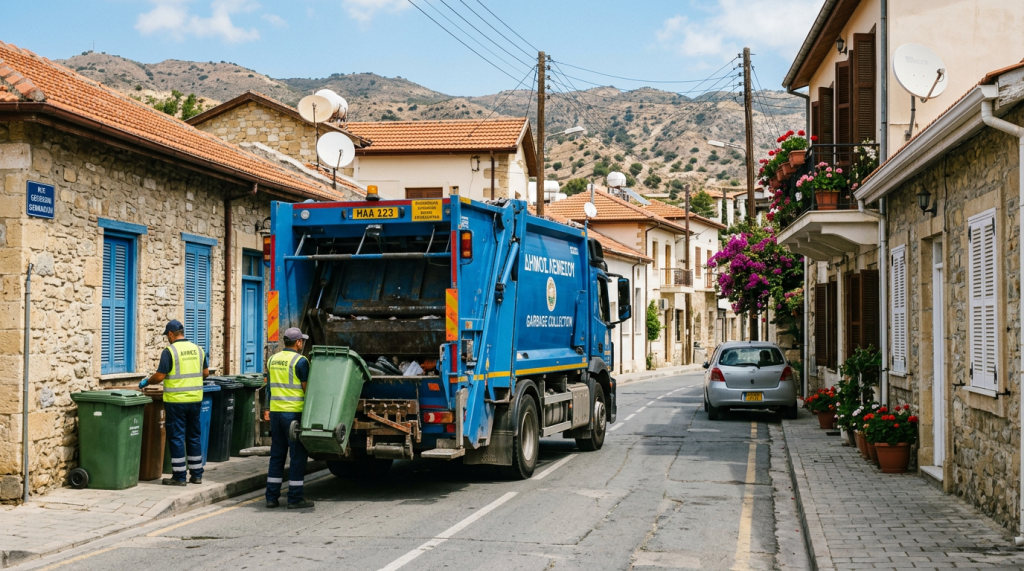
Every week, thousands of garbage trucks drive through Cyprus collecting our household waste. We throw away a bag, the truck takes it away… and then what?
Does everything end up in landfill? Is anything actually recycled? These are some of the most common questions people ask, and understanding the answer is the first step towards making better environmental choices.
This is the first part of the topic using available information materials, ideally I will try to talk to the representatives of Waste Management Facilities and Green Dot to elaborate more on the topic.
STEP 1: Collection
Everything starts with our household bin.
Probably most or all of you taking the garbage bins out twice a week: once PMD bags and paper and the other day of the week: general waste. The mixed household waste (the regular rubbish that doesn’t go into recycling) is collected by your local municipality and transported to one of Cyprus’ Integrated Waste Management Facilities.
Depending on where you live, your waste may be taken to facilities such as Pentakomo (serving much of Limassol) or Koshi (serving Nicosia, Larnaca and Famagusta).
On a different day, recyclable packaging is collected separately: PMD (Package, Metal, Drink cartons)in transparent bags, paper in brown bags. This service is not usually operated by the municipality. Instead, it is managed by Green Dot Cyprus, the country’s collective packaging recovery organization, on behalf of participating municipalities and producers. A common assumption is that all recyclables are mixed together during collection. In fact, Green Dot explains that different material streams are collected separately. In some cases, a specially designed truck may collect both PMD and paper, but the materials remain separated inside the vehicle.
Step 2: Arriving at the Waste Management Facility
The waste management facilities are designed to undergo mechanical sorting, biological treatment and recovery before the remaining residues are landfilled. However, the reality has been more complicated.
Over the past several years, both Pentakomo and Koshi have been at the centre of public debate, parliamentary discussions and media investigations. The facilities have experienced operational difficulties, ageing equipment, contractor disputes and delays in planned upgrades. These issues have affected their ability to operate as originally intended.
After collection, PMD and paper are transported to one of two sorting facilities located in:
- Latsia (Nicosia District)
- Moni (Limassol District)
This is where the real recycling journey begins.
Workers and mechanical sorting equipment separate the mixed recyclables into individual material categories. Once sorted, the materials are compacted into large bales and sold to licensed recycling companies.
Because Cyprus is a relatively small country and does not have large-scale recycling industries for most packaging materials, most paper, plastic and metals are exported overseas, where they are processed into new products.
What about glass?
Glass is the exception.
After being collected from the green bell-shaped containers, glass is transported to facilities, where it is crushed and used as a raw material in the production of construction materials.
According to Green Dot Cyprus, glass is currently the only major packaging material that is recycled within Cyprus.
What Happens If the Wrong Items End Up in the PMD Bag?
Unfortunately, not everything placed in PMD or paper bags can be recycled.
If recycling bags contain food waste, general rubbish or materials that are not accepted by the system, these items cannot enter the recycling stream.
According to Green Dot, unsuitable materials are sent for alternative waste management, including energy recovery where possible. This is why recycling correctly matters. A contaminated bag can make sorting more difficult and reduce the quality of recyclable materials.
Every clean plastic bottle, aluminium can or cardboard box placed in the correct recycling bag helps recover valuable materials that can be used again.
Recycling is not a perfect solution, but separating materials correctly makes the process far more efficient and helps reduce the amount of waste sent to landfill.
 www.natureallydone.com
Leave a comment