
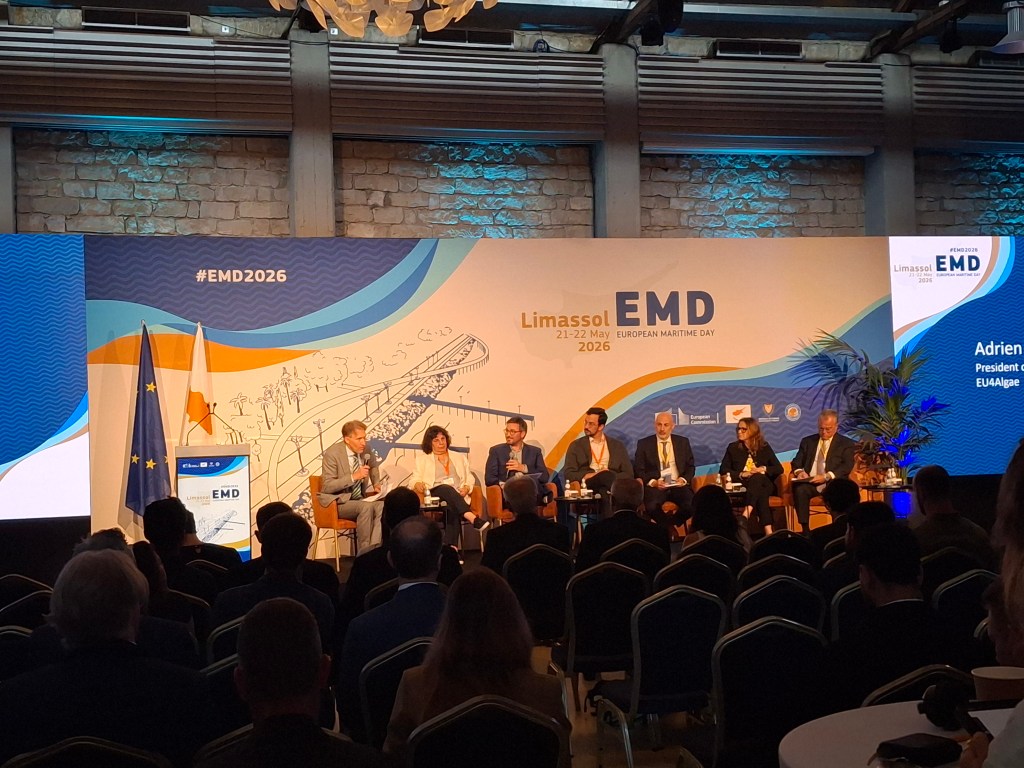
The first day of the European Maritime Day 2026 brought together policymakers, industry leaders, researchers and maritime professionals from across Europe to discuss the future of shipping, ocean sustainability and the blue economy.
Held in Limassol and organised by the European Commission, the Cyprus Shipping Deputy Ministry and the Municipality of Limassol, the conference highlighted one central message throughout the discussions I managed to attend: Europe’s maritime future depends on cooperation, innovation and realistic sustainability goals.
Cyprus Positions Itself as a Sustainable Maritime Hub
Opening the conference, Marina Hadjimanolis, Shipping Deputy Minister to the President of the Republic of Cyprus stressed that the maritime sector must move forward through both leadership and partnerships.
She said the green transition in shipping must remain “realistic and inclusive,” ensuring that no part of the industry is left behind. Cyprus, she noted, is committed to maintaining sustainability at the core of its maritime strategy while continuing to strengthen its position as a reliable international shipping hub.
A strong focus was also placed on people working at sea. Hadjimanolis described seafarers as the backbone of the industry and underlined the importance of preparing the future workforce and inspiring younger generations to pursue careers connected to the blue economy.
The Mayor of Limassol, Yiannis Armeftis highlighted the growing role of local universities and academic institutions in maritime research and sustainable shipping innovation. He mentioned that as a coastal city Limassol understands both the opportunities and responsibilities that come with its close relationship to the sea, adding that maritime development remains central to the city’s future.
Costas Kadis, European Commissioner for Fisheries and Oceans in his welcoming speech referred to initiatives such as Ocean Eye, which aims to improve understanding of marine life and ocean conditions through better data collection and monitoring.
Kadis said the upcoming European Ocean Act, expected by the end of the year, will become an important legislative tool for improving accountability among member states and strengthening ocean data systems for better decision-making.
At the same time, he reminded participants that legislation alone cannot solve every challenge. Long-term progress requires continued collaboration and commitment from governments, businesses and society.
Cooperation Beyond Legislation
A recurring theme during the panel discussions was that regulation by itself is not enough. Charlina Vitcheva, Directorate-General for Maritime Affairs and Fisheries, noted that maritime policy is ultimately about priorities. Where do we spent money? The answer is suggestive: on priorities. She argued that Europe is now making maritime affairs a strategic priority, but maintaining that momentum will require constant effort and political commitment.
Maritime Industry Seen as Key to Europe’s Resilience
One of the day’s major discussions focused on “Blue Leadership” and Europe’s maritime competitiveness.
Speakers highlighted the enormous economic importance of shipping and maritime industries for Europe. Here are just some of the stats mentioned:
- 74% of the EU’s external trade moves by sea
- 97% of cruise ships are built in Europe
- Around 395 million passengers travel by sea annually in Europe
Fotini Ioannidou, Directorate General for Mobility and Transport of the European Commission of the European Commission, said Europe cannot remain sovereign or resilient without a strong maritime sector. She emphasized that ports must become cleaner, smarter, more connected and more secure in order to support Europe’s future competitiveness and energy transition goals. She also warned that strategy alone is not enough without implementation, calling the transition a “collective journey” involving both governments and industry.
The conversation later turned to maritime innovation and technology.
Angelos Tsereklas Zafeirakis, Managing Director of Sotiria Technology explained that innovation should focus on responding to real industry needs rather than trying to predict the future through “crystal ball” thinking.
He pointed to artificial intelligence and digital technologies as already available tools, but said the real challenge lies in implementation, scaling solutions and integrating innovation into local communities and export markets.
Europe’s Shipping Leadership Under Pressure
Questions about how Europe can maintain leadership in global shipping generated some of the day’s strongest discussions.
Themis Papadopoulos, former president of the Cyprus Shipping Chamber emphasized the importance of close cooperation between governments and the private sector. He said shipping policy decisions require continuous dialogue between industry and policymakers.
Papadopoulos also noted that Europe’s ship-owning share has declined over the years and warned about reduced financing availability for shipping compared to pre-2008 levels.
Meanwhile, Polys Hadjioannou, Vice President of Cyprus Union of Shipowners said Europe continues to lead global efforts on maritime decarbonisation and setting standards for sustainable shipping practices.
Another perspective came from Adrien Vincent, Founder and President of Albatros Advisory stressed that maintaining leadership will depend heavily on adaptability as oceans face rising temperatures, acidification and other environmental pressures.
As this was the part of the conference I managed to attend on the first day of European Maritime Day 2026, the discussions already offered a strong overview of the opportunities and challenges facing Europe’s maritime sector.
I also visited the exhibition area where EU-funded projects, research organisations, companies and institutions showcased innovative initiatives connected to marine sustainability, ocean research, blue economy development and maritime technology. The exhibition highlighted how European collaboration is helping drive practical solutions for cleaner shipping, ocean monitoring, marine biodiversity protection and digital innovation in maritime industries.
One thing I personally felt during the event is that it would be valuable to see even more business representatives attending these types of conferences. Many participants were researchers, scientists or people directly involved in sustainability projects, which is extremely important, but sustainability should not remain a conversation only within specialised circles. Businesses across all sectors should care about sustainability, stay informed and actively participate in these discussions.
Written by Lusine Mirzoyan
 www.natureallydone.com
Leave a comment