
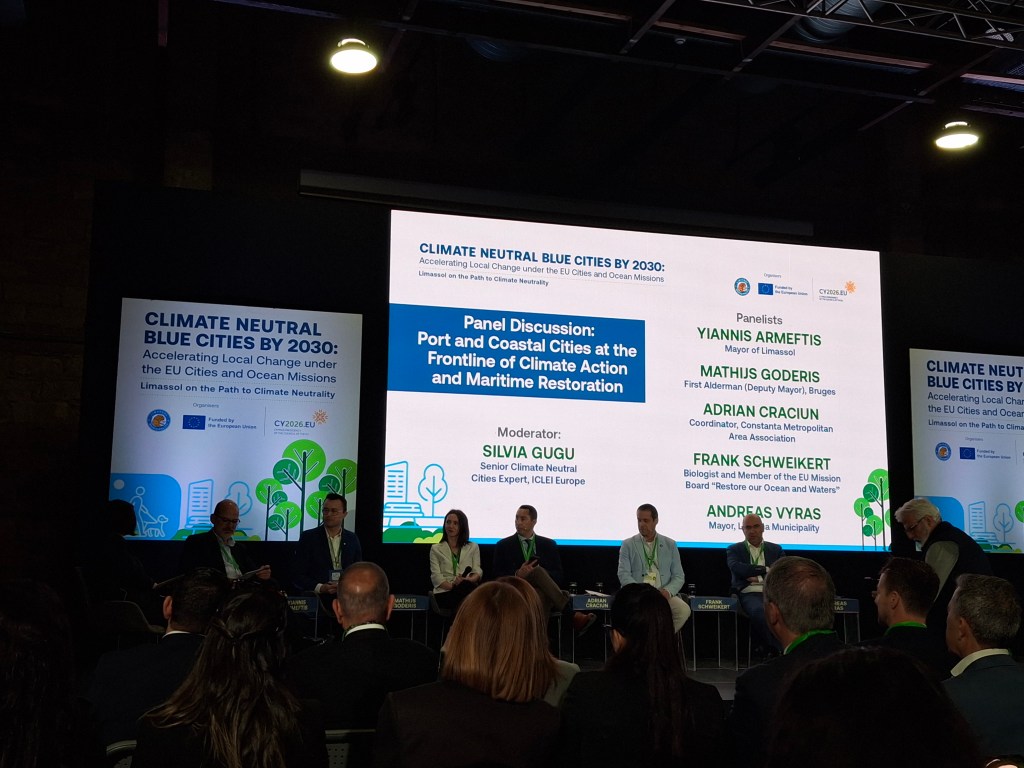
At the Climate Neutral Blue Cities Conference 2030 in Limassol, one thing became clear: the challenge is no longer about ideas or technology. It’s about making things happen.
I managed to attend the Conference on the first day and in this article will summarize some of the main takeouts.
As highlighted during the panel, cities today often work like disconnected systems. Departments, stakeholders, and institutions each hold part of the solution but they are not always aligned. The result is a gap between vision and real action on the ground.
Connecting the Pieces
During one of the discussions it was emphasized the need to better connect:
- city departments (energy, mobility, infrastructure)
- citizens, private sector, and academia
- local, national, and European levels
Without this coordination, even the best strategies struggle to move forward.
Examples from across Europe showed that collaboration is essential. In Spain, cities chose to work together rather than compete building a shared platform that brings municipalities and stakeholders into one ecosystem. The message was simple: no city can achieve climate neutrality alone.
Technology is also playing a growing role in marine protection.
From intelligent robots cleaning plastics to immersive concepts like digital ocean tunnels, innovation is expanding how we interact with and protect marine environments.
As emphasized by Kęstutis Sadauskas, Deputy Director General of the Directorate- General for Maritime Affairs & Fisheries, European Commission, these solutions require significant investment but they are not costs. They are long-term investments in resilience, health, and survival.
From Strategy to Everyday Life
The Mayor of Limassol, Mr Yiannis Armeftis mentioned how small-scale interventions like improving pedestrian and bike access to reconnect the city with its port demonstrate how tactical urbanism can transform previously inaccessible areas into spaces people can actually use and enjoy.
At the same time, efforts to decarbonize port activities and test new mobility solutions show how innovation is being applied in practice, with a clear focus on improving the daily life of citizens.
Andreas Vyras, the Mayor of Larnaca mentioned that a new 4 km beachfront development is being designed with sustainability at its core: from soil decarbonization to tree planting and zero-emission transport.
Learning from Europe
Other cities in Europe are moving fast increasing renewable energy production, exploring new ways to use natural resources like water system, integrating climate goals into infrastructure and planning.
One standout example discussed was a city generating 70% of its electricity from solar and wind aiming for 91% by 2030.
Beyond energy, innovation extends to urban systems:
- environmental city labs monitoring water systems
- exploring how to extract heat from canals
- integrating natural resources into energy solutions
This signals a shift from traditional infrastructure to regenerative urban ecosystems.
At the same time, port cities like those in Romania are aligning infrastructure, business strategies, and climate targets. Notably, Romania reduced its greenhouse gas (GHG) emissions by roughly 56% compared to 1990 levels, exceeding its initial 2030 target already.
The Ocean at the Center
A strong reminder made by Frank Schweikert, member of the EU Mission Board “Restore our Ocean and Waters was the importance of the ocean. It produces most of the oxygen we breathe and absorbs the vast majority of excess heat from climate change, yet it often remains overlooked.
The call was clear and I couldn’t agree more:make the ocean visible, invest in it, and reconnect people with it.
While plastic pollution remains important, it is not the core issue. The real challenge is broader: achieving climate neutrality through systemic change.
This requires:
- collaboration across sectors
- alignment between policy and business
- community engagement
- and above all, actionable solutions
 www.natureallydone.com
Leave a comment